Environmental Footprint of Down vs. Polyester Fill Material
- Author: Long Trail Sustainability
- Date: 11.04.2024
The Challenge
Down and feathers are a byproduct of the global meat poultry industry. Between 2009 and 2013, 2.7 billion ducks and 653 million geese were raised for meat annually, with an estimated 186 million kilograms of down and feathers produced and traded each year. Roughly three quarters of ducks raised for the poultry industry were raised in China; as a result, China is also the world's largest supplier of down and feathers for both apparel and bedding.
With the depletion of natural resources occurring at unprecedented rates and environmental degradation on the rise, organizations and consumers are beginning to make purchasing choices based on the environmental footprints of products. Down is a natural, recyclable material, but does that translate into a lower environmental footprint than polyester
The Approach
The International Down and Feather Bureau (IDFB) commissioned Long Trail Sustainability to conduct a life cycle assessment (LCA) to provide a comprehensive, scientific method to answer the question.
An LCA measures the material and energy inputs as well as waste and emissions of a product, evaluating multiple environmental impact categories (e.g. climate change, ecosystems, etc.) over the lifetime of the product. Because the fill material can be used in so many applications, including apparel (e.g. jackets), home products (e.g. bedding) and outdoor gear (e.g. sleeping bags), the study was cradle-to-gate, encompassing the raw materials used and manufacturing steps, and does not include use in one of the many application listed above or disposal at the end of its lifetime.
In order to make a fair comparison, multiple performance qualities and the duration of the lifetime needed to be incorporated into the functional unit (an LCA's term for the bases of comparison) due to inherent differences between the fill materials. The functional unit was used for the study: Fill material with a CLO3 value of 4.06 (108 grams per square meter of 700 Fill Power down; 230 grams per square meter of polyester) over a lifetime of 5 years.
Participating IDFB members gathered and provided primary data on energy, water and material inputs and waste outputs for processing down fill material for the study under the direction of LTS. where primary data was not available, secondary data and literature values were used for processes outside of their operations. The study used secondary data for the polyester fill material. LTS modeled and analyzed the two different fill materials using SimaPro LCA software.
The Results
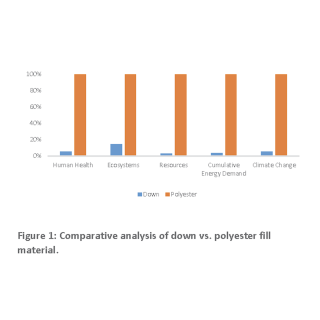
Results indicate that down fill material has between 85% - 97% lower environmental impact in the categories studied, shown in Figure 1. Polyester fill material has 18 times higher climate change impacts than down. Even on a per ton basis (not taking into account performance or duration), down has lower impacts than polyester in all the impact categories analyzed.
The comparative results are considered to have high certainty and to be statistically significant in all impact categories, with one exception, water use. The background datasets used for both down and polyester fill material have high variability in the water use category, causing uncertainty in the water use results. Because statistically significant conclusions cannot be made regarding down or polyester in this category, it was removed from the analysis. Water conservation and recycling is already happening in significant ways for down fill material production in the largest producing country, China, as well as at other participating IDFB members' facilities.
The majority of the environmental impacts of the down fill material come from energy use at the facilities processing the duck/goose feathers. Detergents also have a significant impact in the ecosystem category.
Recommendations for process improvements resulting from the study include:
- Investigating ways to reduct energy usage
- Reduce waste during down fill processing
- Use of renewable energy
- Research and utilize more environmentally friendly detergents to help reduce negative ecosystem impacts